189-2464-6170
 szjhpcb@VIP.126.com



Semiconductors, Chips and PCBs: Clarify Their Hierarchical Relationship
Many people often confuse semiconductors, chips and PCBs. In fact, they are not the same type of component. Instead, they rely on one another, perform distinct roles, and form an indispensable supporting system. Smartphones, computers, home appliances and smart devices we use every day all operate through the combined collaboration of these three elements. To put it simply: semiconductors are foundational materials, chips are core intelligent components, and PCBs serve as the base carrier for electronic components.
I. Semiconductors: Fundamental Raw Materials for Electronic Products
The broadest and most foundational concept among the three, a semiconductor is an electronic material with unique properties. Silicon is its most prevalent core material. Its defining feature is the ability to precisely switch between conductive and insulating states. This characteristic forms the fundamental basis for computation, control and response in all smart electronic devices.
In plain terms, semiconductors are the basic raw materials used to manufacture smart electronic parts. Well-known chips are end products fabricated by precision processing based on silicon semiconductor materials. To simplify: chips are derivatives of semiconductors, and semiconductors form the foundation for chip manufacturing.
II. Chips: The Intelligent Core Brain of Electronic Devices
A chip is a precision electronic component built from semiconductor materials. It integrates countless miniature circuits and transistors within a tiny area and acts as the brain of electronic hardware.
All intelligent functions of equipment are driven by chips. Running mobile applications, computing data on computers, transmitting audio signals in wireless earbuds, and smart regulation of household appliances all rely on chips. Without chips, electronic devices lose the capability to compute, control and respond, becoming nothing more than non-intelligent hardware housings.
However, chips have a critical limitation: they cannot function independently. They must be mounted, powered and wired on dedicated circuit boards to deliver full performance. The carrier holding chips in place is the PCB.
III. PCBs: Carrier & Interconnection Base for Electronic Components
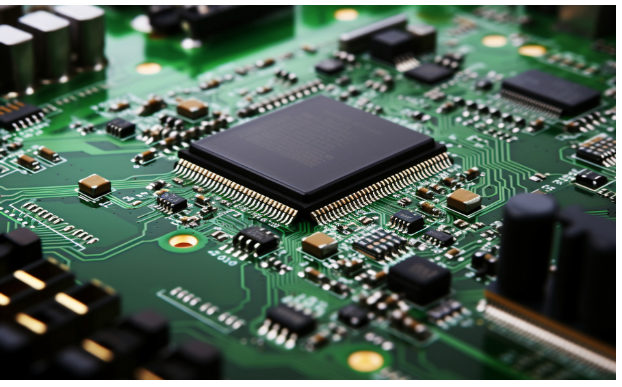
The green or black circuit boards we commonly see are PCBs (Printed Circuit Boards). Unlike semiconductors and chips, PCBs are not made of semiconductor materials and possess no native intelligent capabilities such as computation, storage or control. They have two primary functions: mounting electronic components and forming circuit interconnections.
Covered with intricate traces similar to plumbing and wiring inside buildings, PCBs securely fix chips, resistors, capacitors and all other electronic components, and build complete circuit paths. This enables separate components to work in tandem, receive stable power and transmit signals, unlocking the full intelligent performance of chips.
Reliable mass production of PCBs is vital to electronic product quality. Shenzhen Juehui Weiye Circuit Co., Ltd. specializes in rapid PCB prototyping and small-to-medium batch production. Supported by a digital smart factory, it delivers stable flexible manufacturing capacity, ensuring efficient delivery and consistent finished quality to meet production demands for all types of electronic equipment.
IV. Complete Industrial Hierarchy: Upstream & Downstream Production Logic
Within the full electronics manufacturing workflow, semiconductors, chips and PCBs follow a clear upstream-downstream sequence, forming a complete electronic product manufacturing ecosystem:
First, semiconductor base materials such as silicon wafers are purified and processed — the source foundation of all core electronic devices. Next, precision processes including wafer dicing, photolithography, packaging and testing transform semiconductor raw materials into functional chips. Meanwhile, factories manufacture PCB substrates with elaborate circuit traces. Finally, chips and electronic components are accurately soldered onto PCBs via SMT assembly.
Circuit traces on the PCB connect all components into a complete electronic system, enabling chips to execute computation and control. After final assembly and debugging, finished smart electronic products are ready for end users.
Core Summary
Semiconductors = Raw material: The bedrock of the electronics industry and core material for chip fabrication.
Chips = Core unit: Manufactured from semiconductors; act as the intelligent brain responsible for computation and control.
PCBs = Carrier platform: No built-in intelligence; holds and interconnects all electronic components to realize practical product functions.